Introduction
For most Indians, filing Income Tax Return (ITR) feels like a yearly compliance task – but it is much more than just “paying tax.” Your ITR acts as your financial identity document: it formally records your income, tax paid, and financial discipline in the eyes of the government, banks, and even foreign embassies.
A consistent ITR record strengthens your profile for home loans, visas, higher credit limits, and future financial planning. In this guide, we’ll break down the ITR process for FY 2025–26 (AY 2026–27) in simple language, so salaried individuals, small business owners, and freelancers can take confident, informed decisions.
Why is filing ITR important?
1. Claiming TDS refunds
Most salaried people, freelancers, and small business owners face TDS (Tax Deducted at Source) on salary, bank interest, or professional payments.
If your actual tax liability is lower than the TDS already deducted, you will get that extra money back only if you file your ITR.
Without filing ITR, your refund remains stuck with the government, even though that money legally belongs to you.
2. Essential for loan and visa applications
Banks and NBFCs often ask for ITRs of the last 2–3 years when you apply for:
- Home loans
- Car loans
- Business loans
- Higher credit card limits
Similarly, many foreign embassies consider ITR acknowledgements as proof of income and financial stability for visa applications.
If you are planning a big life goal—house, business expansion, foreign travel—clean ITR history becomes a strong supporting document.
3. Carry forward of capital and business losses
If you made a loss in:
- Shares and mutual funds
- Futures & options (F&O)
- Sale of property
- Your small business or profession
…you can often carry forward those losses and adjust them against future profits—but only if you file your ITR on time for that year.
Skipping ITR for a loss year can permanently block this benefit, costing you money in future high-profit years.
4. Proof of income
ITR acknowledgements are widely accepted as proof of income for:
- Renting a house
- School/college fee financing
- Personal loans or top-up loans
Along with PAN/Aadhaar-linked details, they are also used as supporting proof of residence and financial background, especially in formal or corporate processes.
5. Avoiding late fees under Section 234F
If you miss the due date for filing your ITR, you may have to pay a late fee under Section 234F:
- ₹5,000 if your total income is more than ₹5,00,000
- ₹1,000 if your total income is up to ₹5,00,000
This is in addition to interest on any pending tax.
Filing on time is the simplest way to avoid unnecessary penalties and legal complications.
Who must file ITR for FY 2025–26?
You should file an ITR for FY 2025–26 (AY 2026–27) if you fall into any of the categories below.
1. Income above the basic exemption limit
- Under the Old Tax Regime:
If your Gross Total Income (before deductions like 80C, 80D, HRA, etc.) is more than ₹2,50,000. - Under New Tax Regime:
If your Gross Total Income is more than ₹4,00,000 (since income from 0–4 lakh is taxed at 0% under the 2026 slab structure).
If your income crosses these thresholds, filing ITR is not optional—it is mandatory.
2. High-value transactions (even if income is below the limit)
You may also be required to file ITR even if your income is below the basic exemption limit if you have done any of the following during the year:
- Paid electricity bills exceeding ₹1,00,000 in a year
- Incurred foreign travel expenditure exceeding ₹2,00,000
- Deposited ₹1,00,00,000 or more in one or more bank accounts
These are high-value indicators that trigger reporting requirements, so filing ITR becomes compulsory.
3. Holding foreign assets or having foreign income
If you are a resident and ordinarily resident in India and you:
- Hold foreign bank accounts
- Own foreign shares, ESOPs, or property
- Have signing authority in any foreign account
- Earn income from outside India
…you must file ITR, irrespective of income level.
4. Other common mandatory cases
You must also file ITR if:
- You are a company or firm (filing is compulsory even with zero income)
- Your TDS/TCS exceeds the specified limits
- You are covered under presumptive taxation, but want to declare income below the presumptive percentage
When in doubt, it is usually safer to file than to skip.
Old vs New Tax Regime for FY 2025–26 (AY 2026–27)
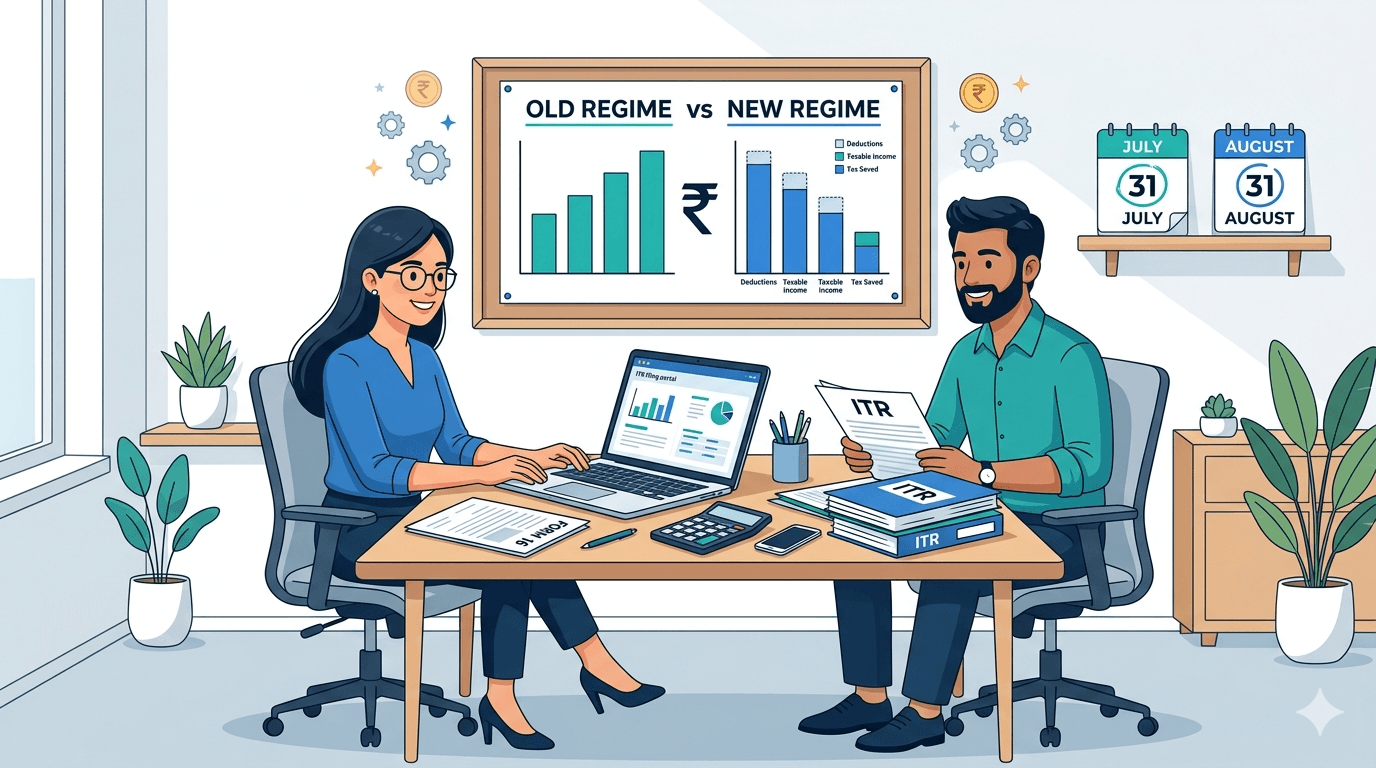
From FY 2025–26 onwards, the New Tax Regime continues as the default for most taxpayers, but the Old Regime remains available as an optional alternative. Choosing between them correctly can save you a significant amount over the long term.
New Regime tax slabs for FY 2025–26
For FY 2025–26 (AY 2026–27), the New Tax Regime slabs are:
| Income range (₹) | Tax rate |
|---|---|
| 0 – 4,00,000 | Nil |
| 4,00,001 – 8,00,000 | 5% |
| 8,00,001 – 12,00,000 | 10% |
| 12,00,001 – 16,00,000 | 15% |
| 16,00,001 – 20,00,000 | 20% |
| 20,00,001 – 24,00,000 | 25% |
| Above 24,00,000 | 30% |
Key features of the New Tax Regime (FY 2025–26)
- Standard deduction:
Salaried individuals and pensioners get a standard deduction of ₹75,000 under the New Regime (increased from the earlier ₹50,000). - Section 87A rebate:
Under the New Regime, the rebate u/s 87A has been enhanced such that eligible resident individuals with income up to ₹12,00,000 effectively pay zero tax (after considering the rebate and standard deduction). - Fewer deductions and exemptions:
Common deductions like 80C (PF, ELSS, insurance), 80D (health insurance), HRA, LTA, and home loan interest on self-occupied property are generally not available under the New Regime.
The idea is: lower rates, less complexity, fewer calculations.
Old Regime in FY 2025–26
The Old Regime continues with comparatively higher slab rates but allows you to claim a wide range of deductions and exemptions, such as:
- Section 80C (PF, PPF, ELSS, life insurance, home loan principal, etc.)
- Section 80D (health insurance premiums)
- HRA (House Rent Allowance)
- LTA (Leave Travel Allowance)
- Home loan interest on self-occupied property (up to specified limits)
- Donations under 80G and many more
Under the Old Regime, the basic exemption limit remains at ₹2,50,000 for individuals below 60.
Old vs New Regime – Comparison Table
Use this table directly in your article:
| Aspect | Old Regime | New Regime (FY 2025–26) |
|---|---|---|
| Basic exemption limit | ₹2,50,000 | ₹4,00,000 (0–4 lakh at 0%) |
| Standard deduction (salary/pension) | ₹50,000 (earlier structure) | ₹75,000 |
| Section 87A rebate | Tax-free up to lower income threshold (earlier 5–7L range) | Effective zero tax up to ₹12,00,000 (eligible resident individuals) |
| Deductions like 80C, 80D, HRA | Available | Mostly not available |
| Ideal for whom? | Heavy investors, home loan takers, those claiming multiple deductions | Those with fewer deductions, simple salary, or minimal investments |
Quick rule of thumb
- If you have:
- Home loanSignificant investments under 80CHRA benefitsHealth insurance and other deductions
- If you don’t invest much in tax-saving instruments or your salary structure is simple, → New Regime with higher standard deduction and 87A rebate up to ₹12L often works better.
Timelines & ITR deadlines for FY 2025–26 (AY 2026–27)
Budget 2026 introduced split deadlines to reduce the load on the e-filing portal, especially distinguishing salaried from non-audit businesses.
Key dates (subject to change via government notifications):
- 31 July 2026
For:- Salaried individuals and non-business taxpayers filing ITR-1 or ITR-2
- No audit requirement
- 31 August 2026
For:- Non-audit business and professional cases (ITR-3, ITR-4)
- Small proprietorships and freelancers without an audit
- 31 October 2026
For:- Tax audit cases (e.g., businesses or professions crossing specified turnover limits)
- 31 December 2026
For:- Belated returns (if you missed the original due date)
- Revised returns (if you need to correct a filed return)
Remember: Delays can attract late fees under Section 234F and interest on unpaid tax, and may affect loss set-off benefits.
ITR Forms: Which one should you use?
Here is a simple mapping to help your readers quickly decide their ITR form:
| ITR Form | Suitable for… |
|---|---|
| ITR-1 (Sahaj) | Resident individuals with: salary or pension, income from one house property, and interest income; usually total income up to a defined limit (commonly ₹50L), no capital gains, no business income. |
| ITR-2 | Individuals/HUFs with salary, multiple house properties, capital gains (shares, mutual funds, property), foreign income/assets, but no income from business or profession. |
| ITR-3 | Individuals/HUFs having income from business or profession (proprietorship, consultancy, trading, freelancing beyond presumptive scheme), along with salary, capital gains, etc. |
| ITR-4 (Sugam) | Resident individuals/HUFs/firms (other than LLP) opting for presumptive taxation under sections like 44AD, 44ADA, and 44AE, with simplified small-business/professional income. |
For accurate filing, always cross-check with the latest official instructions for each ITR on the Income Tax e-filing portal before submitting.
Quick document checklist before you file
You can add this as a highlighted box on your blog:
Basic details
- PAN, Aadhaar, bank account details (with IFSC)
- Address, email, and mobile number linked to OTP
For salaried individuals
- Form 16 from the employer
- Salary slips (for HRA and other breakup)
For interest & investment income
- Form 26AS and AIS/TIS (tax credit and income summary)
- Bank interest certificates, FD/RD interest details
- Dividend statements, mutual fund and share transaction reports
For business owners & freelancers
- Books of accounts or income-expense summary
- Invoices raised and payments received
- TDS certificates (Form 16A) from clients
For capital gains
- Contract notes or capital gains statement from the broker
- Property sale deed and purchase deed details
For deductions (Old Regime)
- 80C investment proofs: PF, PPF, ELSS, LIC, school fee, etc.
- 80D: health insurance premiums receipt
- Home loan interest certificate
- Donation receipts for 80G
FAQ: Common questions for FY 2025–26
Q1. Can I file ITR if my income is below the taxable limit?
Yes, you can file ITR even if your income is below the basic exemption limit.
Many people do this to:
- Claim TDS refunds
- Build a financial history for future loans or visas
- Record capital or business losses properly for future set-off
Voluntary filing is always better than having no record at all.
Q2. What happens if I miss the 31 July 2026 deadline?
If you miss the original due date (31 July for salaried / non-audit individuals):
- You can still file a belated return for FY 2025–26 up to 31 December 2026.
- You may have to pay a late fee under Section 234F:
- ₹5,000 if your income is more than ₹5,00,000
- ₹1,000 if your income is up to ₹5,00,000
- Interest may also be charged on unpaid tax, and you may lose certain benefits, such as the carryforward of certain losses.
Q3. Is the New Tax Regime mandatory?
The New Tax Regime is the default, but not mandatory for most individual taxpayers.
- Salaried individuals can generally choose Old or New Regime each year while filing their return, even if they told the employer something different for TDS.
- If you have business or professional income, switching between regimes is more restricted, so you should take professional advice before locking in your choice.
Q4. Which ITR form is right for me?
- Only salary, one house property, and interest income → ITR-1 (subject to limits and conditions)
- Salary + capital gains / multiple houses / foreign assets → ITR-2
- Business/professional income (proprietorship, consultancy, trader) → ITR-3
- Small business or freelancer under presumptive taxation → ITR-4
When in doubt, read the official instructions of the respective ITR form on the e-filing portal or consult a tax professional.
Treat ITR as your yearly financial health check-up
Think of ITR filing as your annual financial health check-up—not a last-minute headache.
The right tax regime, correct ITR form, and on-time filing can save you money, help you avoid penalties, and build a strong financial identity that banks, employers, and embassies trust. With changes like the higher ₹75,000 standard deduction and the enhanced 87A rebate under the New Regime (making income up to ₹12,00,000 effectively tax-free for eligible residents), personalised planning matters more than ever.
Before you lock in a regime or submit your return, don’t do it alone – get it professionally reviewed. If you’d like personalised help, you can consult me for:
- Choosing the most tax-efficient regime (Old vs New) based on your salary, investments, and loans
- End‑to‑end ITR filing for FY 2025–26, including form selection and error‑free submission
- Guidance on refunds, TDS mismatch, and planning for next year’s taxes
I’ll help you optimise your tax outgo and file your ITR correctly, with complete support until your return is successfully processed. For more details, please visit TaxBrain.